
In Ann Arbor, where the national headquarters for Borders is, they're trying something new. According to USA Today:
"Borders, the nation's second-largest bookstore chain, hopes to reverse years of sluggish sales by reinventing itself as a hub for knowledge, entertainment and digital downloading. Exhibit A is the new store that will open to the public here Thursday — the first of 14 that Borders plans to unveil this year. Borders' plans underscore the anxiety in the bookstore industry, which has been hurt by the growing footprint of online-only sellers.
Can it work? CEO George Jones thinks so. 'We had to build something that would cause the consumer to drive five or 10 minutes past the competitor's store to come here,' says Jones, who joined the company 1½ years ago from Saks."
Faithful readers will remember that I scoffed eighteen months ago when the struggling book behemoth hired a CEO from the fashion world. Maybe I'll have to suck that back--ooh, nasty taste, retracted words--but I don't think so.
AOL quoted this article extensively, with the headline "No One Reads Anymore." And on NPR this morning I heard a study that estimates a growing percentage of the public who never--and they mean NEVER--reads a book, fiction or nonfiction. As I recall, the number has grown substantially in the past forty years, and was over twenty per cent in a study completed in 2002. If that's true, does selling people digital downloads make any difference?
I have said before, and I must say it again, I don't think Borders needs gimmicks. They need BOOKSELLERS. Barnes & Noble, big box behemoth that they are, too, has booksellers. And they have Community Relations Managers who actually talk to the community. Borders has clerks--and stationery, and candy, and a sort of lame coffee shop--but it can be damned hard to find a particular book at Borders.
Yes, there are exceptions. As my dad (a physician) used to say, everybody hates doctors except their own. And there's a really cool woman at my local Borders who cares about our genre, actually reads it, and is willing to stick her neck out to keep my books in stock. Bless her. But ol' George Jones should go out and hire more like her.
Monday, February 18, 2008


Thursday, February 14, 2008
Pimping books

Okay, I'm not at all sure I'm using the verb "to pimp" correctly. David Shuster and I are a little confused on that point. But it's true that HarperCollins is offering free--as in absolutely, without reservation, free--books on its website, beginning Monday. They'll start with this Coelho book, and offer another one every month for the rest of the year.
The idea, evidently, is to entice readers by giving them a sample. “'It’s like taking the shrink wrap off a book,' said Jane Friedman, chief executive of HarperCollins Publishers Worldwide. 'The best way to sell books is to have the consumer be able to read some of that content.'”
Well, yes. But my goodness, the whole book? I wonder how that will work out? And will the author get bupkus for downloaded copies?
In connection with this article, AOL did one of their unofficial surveys about reading habits, and of those responding, 95% said they still prefer to read paper books, page by page. So . . . maybe HarperCollins is right. If readers try Coelho's work and love it, maybe they'll hie themselves out and buy an actual copy. It will be interesting to watch.
Saturday, February 9, 2008
The passing of Margaret Truman

Margaret Truman, the mystery writer, died recently at the age of 83. I wonder how many people recognize her name? She was born in 1924, long before the women's movement, and she said this: "I've had three or four different careers," she told an interviewer in 1989. "I consider being a wife and mother a career. I have great respect for women — both those who go out and do their thing and those who stay at home. I think those who stay at home have a lot more courage than those who go out and get a job."
Miss Truman has always interested me because so far as I know, she was the only working classical singer to transform into a fulltime novelist--and a genre novelist, at that!
I wasn't born when she was singing, and arguably my own musical career was more successful than hers, although less notorious (I'm not, for example, the daughter of a president). But I've always known about her. I can't remember why. And then she went on to write a number of reasonably successful mysteries. The last one, MURDER ON K STREET, was only published last year. Let's be fair and admit that she probably sold lots more copies of her books than I have yet. But I'm still working.
And wouldn't that be nice, to be working right till the end? Rest in peace, Margaret. And congratulations.
Tuesday, January 29, 2008
WICKED is wonderful
A colleague had warned me that the Broadway version of Gregory Maguire's terrific novel WICKED was nothing like the book itself, which I loved. I haven't had a chance to ask her why she felt that way, but my impression was quite different.
We all know the stories of movies eviscerating the books they sprang from, and even a few stories of movies improving upon flawed novels (BRIDGES OF MADISON COUNTY springs to mind, as does THE HORSE WHISPERER.) The musical WICKED, in my opinion, did something different. In a way, it opened up the ideas of the book, made them more accessible, made us in the audience think about how evil is, as both the book and the play assert, sometimes thrust upon us.
I'm not the greatest Broadway musical fan. Particularly in the last fifteen years or so, the music has a sameness that I find tedious. Such a dearth of melody! But the tunes in WICKED, while hardly memorable, weren't bad, and they did take a minor turn once in a while that reflected the sense of the story. And I appreciated not having to put my fingers in my ears, as I did all the way through RENT.
But it was the story I found remarkable. WICKED the musical works beautifully as a play, not so much referencing the original source material, of course--the L. Frank Baum material, that is--but the movie, which is quite a different story. The play has a quite satisfying dramatic arc, and something substantive to say. I found the ending a tad too convenient, but still, it's a delightful show. I'm not surprised Gregory Maguire is so happy with it (according to an essay in the program, written by him.) His novel personalizes a figure we've accepted for years as the embodiment of evil, without backstory or individuality, and the play goes even further to bring this figure to life, although of necessity without the depth of Maguire's characterization.
If you've never read the original WIZARD OF OZ, I recommend borrowing it from the library if you can get it. It's hard to believe that such a primitive work can take on a lasting life of its own, create its own cultural paradigm, grow into a variety of forms. Of course we've all seen the movie. And I hope you'll read Geoff Ryman's odd but fabulous novel WAS, for yet another approach.
And then, when you can, go see the musical. I enjoyed it from beginning to end. Wonderful!
We all know the stories of movies eviscerating the books they sprang from, and even a few stories of movies improving upon flawed novels (BRIDGES OF MADISON COUNTY springs to mind, as does THE HORSE WHISPERER.) The musical WICKED, in my opinion, did something different. In a way, it opened up the ideas of the book, made them more accessible, made us in the audience think about how evil is, as both the book and the play assert, sometimes thrust upon us.
I'm not the greatest Broadway musical fan. Particularly in the last fifteen years or so, the music has a sameness that I find tedious. Such a dearth of melody! But the tunes in WICKED, while hardly memorable, weren't bad, and they did take a minor turn once in a while that reflected the sense of the story. And I appreciated not having to put my fingers in my ears, as I did all the way through RENT.
But it was the story I found remarkable. WICKED the musical works beautifully as a play, not so much referencing the original source material, of course--the L. Frank Baum material, that is--but the movie, which is quite a different story. The play has a quite satisfying dramatic arc, and something substantive to say. I found the ending a tad too convenient, but still, it's a delightful show. I'm not surprised Gregory Maguire is so happy with it (according to an essay in the program, written by him.) His novel personalizes a figure we've accepted for years as the embodiment of evil, without backstory or individuality, and the play goes even further to bring this figure to life, although of necessity without the depth of Maguire's characterization.
If you've never read the original WIZARD OF OZ, I recommend borrowing it from the library if you can get it. It's hard to believe that such a primitive work can take on a lasting life of its own, create its own cultural paradigm, grow into a variety of forms. Of course we've all seen the movie. And I hope you'll read Geoff Ryman's odd but fabulous novel WAS, for yet another approach.
And then, when you can, go see the musical. I enjoyed it from beginning to end. Wonderful!
Thursday, January 17, 2008
The write priority
Sent by my buddy Sharon Shinn:
"When writing a novel that's pretty much entirely what life turns into: 'Houseburned down. Car stolen. Cat exploded. Did 1500 easy words, so all in all it was apretty good day.'" -Neil Gaiman
And I remember William Gibson saying: "Writing a novel is mostly just walking around and worrying if it will work out."
"When writing a novel that's pretty much entirely what life turns into: 'Houseburned down. Car stolen. Cat exploded. Did 1500 easy words, so all in all it was apretty good day.'" -Neil Gaiman
And I remember William Gibson saying: "Writing a novel is mostly just walking around and worrying if it will work out."
Tuesday, January 15, 2008
Let's talk about plagiarism
Okay, there seems to be consensus that Cassie Edwards is too old to beat up on. She even puts her age on her MySpace page, 71--the page is all in pink, by the way. Naturally.
The issue stealing from other authors is being chatted up all over the internets now, with this poor senior lady at its center. So the question becomes, "What is plagiarism?" Crediting sources? Footnotes?
I'm working on a novel with lots of historical references now, and I'm certainly keeping a bibliography, in case I need to re-check something. Maybe--maybe that bibliography will go on the web page for the book, but it doesn't belong in the back of a piece of fiction.
Footnotes worked gloriously for Susannah Clarke's JONATHAN STRANGE AND MR. NORRELL, but they were part of the entertainment. They were funny and colorful and beautifully written. They had nothing to do with sources, and I don't think footnotes in fiction ever work unless they serve the purpose Ms. Clarke put them to.
It seems perfectly clear to me that plagiarism means lifting whole passages out of another author's work and putting them in your own. A little modification doesn't alter the fact that somebody else wrote the passage. And I don't think any writer--student, beginning author, or 71-year-old romance novelist--could mistake that for anything but what it is, stealing.
As has been pointed out on another forum, in science fiction we're all riffing off each other's ideas. Ideas are at the heart of what we do in sf, and there's no patent on them. Where we would get in trouble would be directly quoting another author without saying that we're doing so. Duh.B
ut gosh, I would hate, at the age of 71, and having published 100 novels, to have my career falling around my ears in such a fashion. I think I'm feeling more sorry for the lady in question than outraged. Her pride must be in tatters.
My pride, I feel sure, would have forestalled me doing any such thing in the first place.
The issue stealing from other authors is being chatted up all over the internets now, with this poor senior lady at its center. So the question becomes, "What is plagiarism?" Crediting sources? Footnotes?
I'm working on a novel with lots of historical references now, and I'm certainly keeping a bibliography, in case I need to re-check something. Maybe--maybe that bibliography will go on the web page for the book, but it doesn't belong in the back of a piece of fiction.
Footnotes worked gloriously for Susannah Clarke's JONATHAN STRANGE AND MR. NORRELL, but they were part of the entertainment. They were funny and colorful and beautifully written. They had nothing to do with sources, and I don't think footnotes in fiction ever work unless they serve the purpose Ms. Clarke put them to.
It seems perfectly clear to me that plagiarism means lifting whole passages out of another author's work and putting them in your own. A little modification doesn't alter the fact that somebody else wrote the passage. And I don't think any writer--student, beginning author, or 71-year-old romance novelist--could mistake that for anything but what it is, stealing.
As has been pointed out on another forum, in science fiction we're all riffing off each other's ideas. Ideas are at the heart of what we do in sf, and there's no patent on them. Where we would get in trouble would be directly quoting another author without saying that we're doing so. Duh.B
ut gosh, I would hate, at the age of 71, and having published 100 novels, to have my career falling around my ears in such a fashion. I think I'm feeling more sorry for the lady in question than outraged. Her pride must be in tatters.
My pride, I feel sure, would have forestalled me doing any such thing in the first place.
Monday, January 14, 2008
Plagiarism, Romance, and Readers

Poor Cassie Edwards! Cassie is the author of more than 100 romance novels, delighting her readers with such titles as SAVAGE LONGINGS, SAVAGE MOON, and SAVAGE BELOVED (that one sounds fun, doesn't it?) Apparently she writes historical romance about Indians. Never mind all the issues I have with romantic views of Indians, since I are one, but imagine this: she's been cheating, and her READERS outed her!
In the New York Times, Felicia R. Lee (see, I'm being very careful to credit my sources) writes that Cassie's readers caught passages lifted directly from research materials. The whole article is here: http://www.nytimes.com/2008/01/12/books/12roma.html?_r=1&scp=1&sq=Romance+novelist+accused&oref=slogin (The best part is a link to blog called SmartBitchesTrashyBooks.com. I might like a blog by that name.)
And in her defense: "Ms. Edwards told an Associated Press reporter earlier this week that she did not know she was supposed to credit her sources. “When you write historical romances, you’re not asked to do that,” she said."
Okay, I've written historical, and of course I've done tons of research for my sf. I use the material, but I don't quote it. How boring would that be? This whole thing seems very odd to me, and I'm sure it will all blow over.
The part I can't get over is that the readers turned on her, like a pack of dogs chasing a rabbit! I don't know if I'm more stunned that they cared about the issue, or that romance readers found comparisons between a novel and a historical source. Maybe they really are SmartBitches. Bless 'em.
Sunday, December 30, 2007
The trouble with used book sales

The following post is mostly quoted from a position paper published by Novelists, Inc. (NINC). The subject is one that worries a lot of us, and in my opinion, NINC has come up with a significant and well-informed position on the matter. It satisfies both my worry that my used book sales do nothing to help my publisher or me, and my guilt over the fact that I, too, buy used books, especially the very expensive reference books all writers have shelves and shelves of!
So here are a some of the most cogent passages. Many thanks to NINC and to the SFWA Forum for making this available:
"Novelists, Inc. (NINC) is a non-profit organization of professional published authors dedicated to advancing the interests of working writers. Used book sales, particularly sales of used books through the Internet, have a significant negative effect on the income of publishers, and, therefore, authors, as there is no remuneration to them for any sales of used books. This document is intended to focus attention on NINC's position that the copyright clause of the Constitution of the United States stands for the principle that authors and publishers have the right to share in the profits that others make from the sale of their work. Currently, authors and publishers do no share in the profits made through the sale of used books, a multi-billion dollar enterprise."
"In 2005, in an effort to understand the used-book industry and its scope, the Book Industry Study Group, Inc. (BISG) hired a consulting firm to conduct an in-depth study of used-book sales and the used-book industry in the United States. The study indicated that the negative effect of used-book sales on the book publishing industry is growing rapidly and bears serious consideration."
"NINC holds a firm position in favor of Federal legislation to combat the potentially damaging effect of used book sales on the current and future health of the publishing industry. Such legislation would be grounded in the intent of the language of Article I, Section 8, Clause 8 of the Constitution of the United States, which states that:'
The Congress shall have Power . . . To promote the Progress of Science and useful Arts, by securing for limited Times to Authors and Inventors the exclusive Right to their respective Writings and Discoveries.'"
In short, NINC proposes that a percentage of fees be paid ("Secondary Sale" fees) upon the reselling of any book within two years of its original publication date. A percentage of these fees would then transfer to authors.
Make no mistake, this is a serious issue. New contracts for authors are routinely, these days, being negotiated on past sales. And those past sales are NEW book sales. All those used books that crop up on Amazon before the new book is even available cost their authors money. I like NINC's proposal, because it doesn't ban the selling of used books, or even scold those of us who buy them, but make provisions for the publishers and authors to be compensated. For some writers, such a provision could be career-changing. And for readers, it means the variety of books available to them will be protected. Such a move would go a long way toward offsetting the best-seller, big box store mentality that assails publishing in this decade. I hope it works out.
Tuesday, December 18, 2007
The art of book promotion

Poor Ann Coulter. Did no one explain to HER that she has to promote her book?
Her newest hatefest, IF DEMOCRATS HAD ANY BRAINS, is tanking. Her last book spent twelve weeks on the New York Times bestseller list, but this one only lasted four. Her last book sold 223,000 copies in its first month out, and this one only 97,000.
Now all of us out here in genre-land know that you have to blog, you have to print up bookmarks, you have to do appearances, you have to work the system. Reviews don't help, Ann. (Well, in your case, they really don't help, since they're ghastly.) You have to work at this, not just write two hundred pages of tripe and expect it to sell!

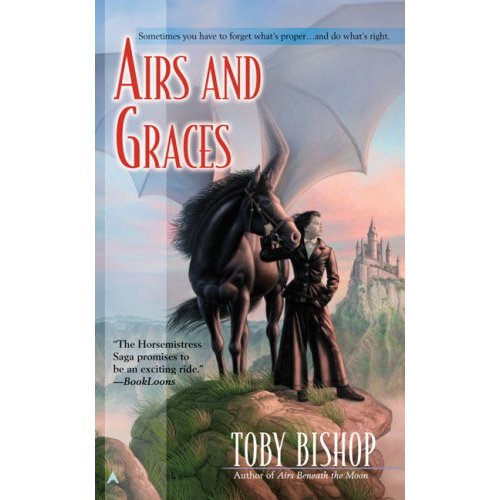
Toby Bishop understands all this. The androgenous writer of AIRS BENEATH THE MOON is celebrating the appearance of the second book in the trilogy, AIRS AND GRACES, which is released this very day, December 18th. Toby's smart, and has sent e-mails to all and sundry, refreshed the website (http://www.tobybishop.net/, if you want to know). Or eager readers can visit http://www.amazon.com/Airs-Graces-Toby-Bishop/dp/0441015565/ref=sr_1_1/002-7963065-4204831?ie=UTF8&s=books&qid=1187052410&sr=8-1 Toby doesn't expect great reviews alone to sell books.
Of course, Toby doesn't go around in an assortment of inappropriately skimpy little black dresses, either. Maybe that's how Coulter went wrong?
Wednesday, December 12, 2007
The stuff of science fiction

It's hard to write sf that's wild enough to compete with the truth these days. Here's a quote from the IPCC in Bali that will give you the chills:
"Dec. 12, 2007 How dire is the climate situation? Consider what Rajendra Pachauri, the head of the United Nations' prestigious Intergovernmental Panel on Climate Change (IPCC), said last month: "If there's no action before 2012, that's too late. What we do in the next two to three years will determine our future. This is the defining moment." Pachauri has the distinction, or misfortune, of being both an engineer and an economist, two professions not known for overheated rhetoric."
We've all read doomed planet scenarios, of course. But have we read the ones in which ultraconservative politicians and mentally lazy consumers deny the evidence laid out for them?
According to Technorati.com: ". . . as of Dec. 11, the synthesis report had some 265 blog reactions, where the Aug. 24 YouTube video of Miss Teen South Carolina struggling to explain why a fifth of Americans can't locate the U.S. on a world map had more than 5,300 blog reactions."
The whole article is here: http://www.salon.com/news/feature/2007/12/12/ipcc_report/ And it ends this way: "Or perhaps we could videotape Miss Teen South Carolina trying to explain why Americans still refuse to take serious national action on climate change. "
I suppose exploring this wouldn't make as exciting a story as, say, the planet blowing up and shooting bits of itself all over the 'verse, but it would be real science. I'm just not sure I have the internal fortitude to take it on.
Wednesday, December 5, 2007
Earth that was


I felt a little spurt of hope for the planet when I read an introduction to The Presidential Climate Action Project. Sixty leading scientists, including a former NASA director, have compiled a 100-day plan to reverse global warming, to be implemented in 2009. It appears to be a real, considered response to the urgency of climate change, and its members assert that it's nonpartisan, to be put in the hands of whoever our new leader may be.
I had that old Star Trek feeling--you know, the one where Earth actually survives, where humans work together to solve problems, and have the wherewithal to explore new frontiers, where no one has gone before?
For example:
Government's Atmospheric Trust Responsibility
An Essay by Mary Christina Wood
In this essay, Professor Wood presents a framework for holding government at all levels responsible for reducing greenhouse gas emissions. She draws upon the Target for U.S. Emissions Reductions recently released by scientists to contend that government has a duty to cap emissions by 2010, reduce emissions by 4% annually thereafter, and ultimately bring emissions down to at least 80% below 2000 levels by 2050. As she explains, there can be no "orphan shares" in meeting this planetary carbon liability. She explains that government has the tools to accomplish this, and as a sovereign trustee of our atmosphere, has the obligation to do so.
And here's the site:http://www.climateactionproject.com/
Please, no one burst my bubble. It feels so good to have this optimistic moment. I love FIREFLY, but the idea of a vanished Earth is just too sad.
Sunday, December 2, 2007
More on research as timesuck
I confess, I haven't gotten as much done as I might have these past two days, because not only did my own research lead me off on tangents, but links from other people distracted me even more. But who knows? These things might turn into stories some day.
So one last link, because Derek Lee Ragin was, when I was singing Bach and Pergolesi and Handel, the reigning countertenor of the day. His voice, combined with a female soprano's, created the lovely soundtrack for the film FARINELLI. (If you haven't seen it, rent it! It's beautiful.)
Here's Derek, with my comments: the tempo is a bit too fast, because even though his coloratura (very fast notes) is remarkable, he's struggling to get all the notes into the time framework, which means a slightly slower tempo could have made the whole piece easier to listen to (and to watch.) I love the fact that there's video, because it gives the listener a chance to observe his technique, and not guess at it. If you're interested in the fine points, his steady stance and relaxed jaw are essential to the breath support, which comes from below the rib cage. The movement in his jaw and mouth are because of the quick coloratura, because the singer has to constantly release any tension so as not to obstruct the flow of sound.
And do observe these marvelous violinists! These musicians are hardly glamor girls, but wow--can they play. Wonderful baroque precision and phrasing. This is almost a duet between the principal violinist and the singer.
And also notice, if you're one of those who likes to write about classical music, how the orchestra applauds: they lightly click their bows on their music stands. Such a cool detail to use someday, isn't it?
Too much information? Just watch, and enjoy: http://www.youtube.com/watch?v=IfNAGm0bjL4
So one last link, because Derek Lee Ragin was, when I was singing Bach and Pergolesi and Handel, the reigning countertenor of the day. His voice, combined with a female soprano's, created the lovely soundtrack for the film FARINELLI. (If you haven't seen it, rent it! It's beautiful.)
Here's Derek, with my comments: the tempo is a bit too fast, because even though his coloratura (very fast notes) is remarkable, he's struggling to get all the notes into the time framework, which means a slightly slower tempo could have made the whole piece easier to listen to (and to watch.) I love the fact that there's video, because it gives the listener a chance to observe his technique, and not guess at it. If you're interested in the fine points, his steady stance and relaxed jaw are essential to the breath support, which comes from below the rib cage. The movement in his jaw and mouth are because of the quick coloratura, because the singer has to constantly release any tension so as not to obstruct the flow of sound.
And do observe these marvelous violinists! These musicians are hardly glamor girls, but wow--can they play. Wonderful baroque precision and phrasing. This is almost a duet between the principal violinist and the singer.
And also notice, if you're one of those who likes to write about classical music, how the orchestra applauds: they lightly click their bows on their music stands. Such a cool detail to use someday, isn't it?
Too much information? Just watch, and enjoy: http://www.youtube.com/watch?v=IfNAGm0bjL4
Friday, November 30, 2007
Eight books for Christmas
This is a newsletter I sent to my readers' list, so a few of you might have already read it. You may disregard, in that case. But remember, when you can, to patronize your local independent bookstore!
Hi, friends:I'm writing this on the day after Thanksgiving, called Black Friday by retailers. The traditional explanation for the name is that this is the shopping day that puts retailers in the black. Here's a different take: according to http://thecitydesk.net/ there was a Lawrence Black who was a famous salesman for Osberger's Department Store, which is now Macy's. He always wore a black suit, and was respected by everyone in the trade. When he died late in November in 1964, clerks all around the city wore black as a tribute to him. The next year, on the day after Thanksgiving, they wore black to remember him, and thus the tradition began.Black Friday always means it's time to think about Christmas gifts.
I hope you'll think about books, for young and old alike. I had the great good fortune to attend a science fiction conference in Nantes, France this year, and through that event and others I've found some new writers (to me) and won new respect for writers I already know well. So here's a short list of books I recommend, with tags for the readers I think will most appreciate them. I had three books of my own come out this year--including one reprint--and those are here, too.
And please, when you can, order from your local independent bookstore! It's not always possible, of course, not even for me. But it would be nice to do all we can to stop our independents from disappearing.
Here's my Black Friday list, in no particular order:
Miracle and Other Christmas Stories, Connie Willis: charming, funny, and moving holiday stories for adults and young adults of all interests. Not a new book, but one I bring out every year to enjoy again.
 Bright of the Sky, Kay Kenyon: big, colorful space opera with a great hero and a fantastic new universe. This book has that Kenyon edge, and is a great read for lovers of really good science fiction. Got a starred Publishers Weekly review, too!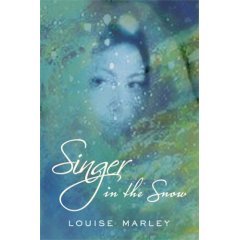
Singer in the Snow, the paperback version. It makes a good gift for young adult readers in this affordable format. And by the way, the original trilogy of The Singers of Nevya is due to be reprinted in 2009! I'm thrilled about that, and I'll let you know. (I'd also love to know if you think an omnibus or three separate books would be best.)
Old Man's War, by John Scalzi, is an entertaining piece of military science fiction. I don't usually read much in that genre, but I enjoyed this, and it made a great birthday gift for my brother-in-law who is a veteran. He liked it a lot.Last Summer of the Apocalypse, by James Van Pelt. Fabulous novel, which is getting a lot of critical attention--a coup for the small press (Fairwood) which published it. A refreshing character-driven take on the post-apocalyptic genre.
Absalom's Mother & Other Stories, which Fairwood also published. This is a collection of my short stories, everything from time travel science fiction to musical fantasy. Most have been published before, but there are two new ones. I think these are best for adults, although young adults who read at a high level will also enjoy them.
The Glass Castle, by Jeannette Walls. This is NOT science fiction. In fact, it's all true, a memoir, one of the most compelling reads I've ever picked up. I just have to pass it along. I think it's an outstanding choice for women readers on your gift list. I loved it, my mom loved it, and my sisters loved it.
Last but not (I hope) least, Airs and Graces, the second book in The Horsemistress Saga, by Toby Bishop. Toby is me, of course. Airs and Graces should be suitable for adults or older young adults (there's a bit of offstage sexual inference--my teenage students thought that any concern about that was pretty funny, but just so you know!)
I wish you peace and joy through this whole season. I hope you'll let me know if you enjoyed some of these special books!
Louise
Saturday, November 24, 2007
The crap we put out

There's a principle in fiction, ably outlined by Don Maass in his book WRITING THE BREAKOUT NOVEL, which states that when things are going badly for your characters, make them worse. I doubt anyone follows this rule more closely than Stephen King, and though I don't read much horror, there are some of his pieces, CARRIE in particular, which I admire. But honestly . . . the movie based on his novella THE MIST takes the rule much too far. To quote my mentor, another writer I admire deeply: Greg Bear said once, when I was his student at Clarion West, that "we have to take responsibility for the crap we put out." Director Frank Darabont has a lot of crap to answer for.
Here's what happened: Beloved husband and I went to the theater to see ELIZABETH, which had unaccountably already departed. Because it was beloved husband with me, I agreed to see the only other film that even came close to being interesting, and it was THE MIST. Blech. Dreck. Intriguing only because of what it did wrong.
Now, this is just opinion, and it comes from someone who thought that THE KITE RUNNER's plot was unfailingly bleak and nearly sadistic. I tell you that to give you perspective. But after Darabont took the essence of King's novella and blew the fun right out of it, he decided--on what authority I can't imagine--to change the ending. Okay, in case you just have to see the 2007 version of a 1950's creature feature, I won't tell you how he changed it. Suffice it to say that as we walked out of the theater people were either 1)laughing (that was us) 2)snarling at what a bad movie it is, or 3)shaking their heads in confusion.
Principles are fine, but judgment is good, too. We writers can go too far.
Thursday, November 22, 2007
Beowulf and the Lord of the Rings

Gary Kamiya, in a lengthy article on Salon.com, (see http://www.salon.com/) writes a scathing review of the new film Beowulf, while at the same time illuminating the meaning of this old, old poem (probably written around the year 1000 A.D.,looking back on a story already five hundred years old.) He quotes from an essay by Tolkien, who dismisses the pedantic sophistry of critics of the epic poem:
"Beowulf: The Monsters and the Critics," published in 1936, marked a turning point in critical studies of the poem. Before Tolkien's essay, most scholars regarded the unknown poet's use of supernatural elements -- the monster Grendel, his equally monstrous mother, and the dragon -- as primitive or childish. Arguing that these "trivial" themes failed to do justice to the poem's exquisite language, they saw "Beowulf" as being primarily of historical, not artistic, interest. As the scholar W.P. Ker wrote in 1904, "The thing itself is cheap; the moral and the spirit of it can only be matched among the noblest authors."
Tolkien overturned these assumptions. He argued that the poem should be read as a poem, and recognized as a great one. The fantastic elements in "Beowulf," far from being faintly embarrassing, were inseparable from its majestic artistry. In a famous allegory, Tolkien compared the author of "Beowulf" to a man who, inheriting a field full of ancient stones, used them to build a tower. His friends, recognizing that the stones had belonged to a more ancient building, tore down the tower "in order to look for hidden carvings and inscriptions." What they did not realize, Tolkien ends, was that "from the top of that tower the man had been able to look out upon the sea."
Tolkien's point is that the fantastic elements in "Beowulf" are ancient archetypes that have deep roots in human beliefs, fears and wishes -- myths, in other words. And in "Beowulf," he argues, these myths are an essential part of a tragic tale whose theme is "man at war with the hostile world, and his inevitable overthrow in Time." The greatness of Beowulf derives from the fact that it is a poem created in "a pregnant moment of poise": It is balanced between a Christian worldview, in which death and defeat are ultimately themselves defeated by Christ, and a Germanic, pagan one, in which fate rules all and man's courage alone confers nobility. It is, Tolkien writes, not a primitive poem, but a late one. The pagan world is already past, but the poet still celebrates its vanished power. The fact that a poem written more than a thousand years ago was itself looking back at a lost world gives the poem an uncanny double resonance to the modern reader: "If the funeral of Beowulf moved once like the echo of an ancient dirge, far-off and hopeless, it is to us as a memory brought over the hills, an echo of an echo."
Tolkien's brilliant essay can be seen as a ringing defense not just of "Beowulf," but of the work he was soon to embark on, another great tower composed of ancient stones. And the themes of lateness, of heroic loss, being caught between one age and another (his world is not called "Middle-earth" for nothing), are the deepest and most sublime parts of his own epic: They are the haunted metaphysical atmosphere through which his characters -- men, elves and hobbits alike -- must make their way. The coming disappearance of the elves, the hard dawning of the age of men, represent a disenchantment of the world identical to the disenchantment Tolkien found so unbearably moving in "Beowulf."
By introducing this dark note, Tolkien gave artistic expression to the doubts that he himself may have felt about the myth he had created -- and so transcended them."
As a genre reader and writer, I found this particularly cogent. Kamiya compares the Hollywood cartoonish representation of Beowulf with Peter Jackson's deeply respectful version of Lord of the Rings in a way that makes sense to me. It's no accident that the images and ideas of Tolkien have so permeated modern life, even harkening back, as they do, to an earlier time. It's worth reading the whole article.
Monday, November 12, 2007
Second matron lit book report

I'm thinking this genre just isn't for me, except for my friend Catherine's wonderful story. I've just tried to read THE LADIES OF COVINGTON SEND THEIR LOVE, as part of my commitment to you, the readers--so you don't have to.
There were a few moments in this book when I thought, okay, I see the charm. But they just didn't last. In yet another example of why Louise Marley does NOT have her finger on the public pulse, I found the writing sophomoric, the story obvious and unsubtle, and the characters labored.
You need to know, though, that the book was successful enough to spawn a series, so clearly not all readers suffered my reaction. Call it boomer lit, granny lit, or Catherine's wonderful moniker elder chick lit--I'm two titles down the list now, and I'm still not getting it. (In case you missed the earlier post about this new genre, the article that inspired my search is here: http://www.csmonitor.com/2005/0202/p14s01-legn.html
On the other hand, on my recent trip I finally got to read Connie Willis' TO SAY NOTHING OF THE DOG. It made me lament once again the assertions of so many readers that they "never read science fiction." Connie's fabulous novel succeeds on every level: sophisticated prose, terrific character development, exquisite historical detail, laugh-out-loud humor, and an outstanding illumination of a scientific principle, in this case, chaos theory. It's simply tragic that Connie isn't sitting in the mainstream section with Gregory Maguire, Audrey Niffenegger, and yes, even Margaret Atwood. The reading public is missing some remarkable literature.
IMHO. Ahem.
Sunday, November 11, 2007
PW Best Books of the Year
I knew Kay Kenyon was on to something when my twenty-something son couldn't put her new book down. And now, stunningly, Publishers Weekly has named BRIGHT OF THE SKY to its Best Books of the year list! This is huge. There are only seven sf novels on the list.
PW reviewed over 6,000 books this past year (did you know three thousand books are published daily in this country? Brrrrr.) Out of those 6,000 PW choose 150 (no, I'm not missing a zero) and Kay's wonderful romp of a book, with its drop-dead gorgeous Stephan Martiniere cover, is on that short list!
If you'd like to see the whole thing, in preparation for your Christmas shopping (!!!!!) here's the link: http://www.publishersweekly.com/article/CA6496987.html
And by the way, Stephan's work is quite well-known in France, I learned. Deservedly so. Kudos to Lou Anders at Pyr Books for this achievement, and for recognizing excellence when they see it.
PW reviewed over 6,000 books this past year (did you know three thousand books are published daily in this country? Brrrrr.) Out of those 6,000 PW choose 150 (no, I'm not missing a zero) and Kay's wonderful romp of a book, with its drop-dead gorgeous Stephan Martiniere cover, is on that short list!
If you'd like to see the whole thing, in preparation for your Christmas shopping (!!!!!) here's the link: http://www.publishersweekly.com/article/CA6496987.html
And by the way, Stephan's work is quite well-known in France, I learned. Deservedly so. Kudos to Lou Anders at Pyr Books for this achievement, and for recognizing excellence when they see it.
Plus ca change . . . sf in Europe
In discussions with the French editors and publishers at Les Utopiales, Richard Paul Russo, Greg Keyes, and I learned over a VERY late dinner that the same issues that challenge science fiction publishing in the States are nagging at the genre in France. The biggest difference is that their 7% slice of the market (ours is 7% also in the U.S.) is 7% of a considerably smaller pie. Science fiction and fantasy writers in France don't make a living. Period.
It was the one question we were all asked: "Do you make a living by writing?" Of course, the answer varied for all of us, but I think we could all more or less say yes--some more definitively than others! (See my brave smile when I say that.)
I would have thought, seeing this conference with its thousands of attendees, that the situation was different in France, but no. And in Italy, evidently (this is all anecdotal, except for my tours of several bookstores in Milan) the situation is even tougher.
So what's selling best in France? Not bookstop fantasies, apparently, but space opera! That at least seems to be a slightly different trend than in the U.S.
I felt such a nice connection to all of these people, publishers, editors, and writers alike. We're rowing the same boat. The great thing is, we all like the boat just fine.
It was the one question we were all asked: "Do you make a living by writing?" Of course, the answer varied for all of us, but I think we could all more or less say yes--some more definitively than others! (See my brave smile when I say that.)
I would have thought, seeing this conference with its thousands of attendees, that the situation was different in France, but no. And in Italy, evidently (this is all anecdotal, except for my tours of several bookstores in Milan) the situation is even tougher.
So what's selling best in France? Not bookstop fantasies, apparently, but space opera! That at least seems to be a slightly different trend than in the U.S.
I felt such a nice connection to all of these people, publishers, editors, and writers alike. We're rowing the same boat. The great thing is, we all like the boat just fine.
Saturday, November 10, 2007
Les Utopiales

This conference was impressive in every way. Organization, the fan base, the contributors, the editors and translators who were there, and the fact that an entire conference devoted to addressing global climate change was--wait for it--UNDERWRITTEN BY THE GOVERNMENT. Not ours, of course. France's.

I met some marvelous new fans for THE GLASS HARMONICA, in Thibo's translation.
And I met a pack of young editors who are both smart (speak very good English) and chic (always a winner for me.) I swear, if they'll have me back, I'll triple the amount of French I speak! Most of my reasonable conversations were with cab drivers and waiters.
Many thanks to my French-speaking buddy, Catherine Whitehead, for keeping me company. And it was lovely to spend time with new friends John Scalzi, the amazing Jim and Cathy Morrow, the charming Greg Benford (who you may know is a reasonably intelligent man) :-) and of course, my good friend Richard Paul Russo. I know I'm forgetting someone, but my head is still full of all the information I picked up on my whirlwind research trip to Milan and La Scala.
I had over three hundred e-mails to deal with when I got home. Mostly spam and politics, of course. If you e-mailed me and I haven't answered yet, hang on!
Friday, October 26, 2007
Diversity in speculative fiction
Seattle writer and literary critic Nisi Shawl has written an interesting article about some new works of speculative fiction that span the compass from the medieval period to the future, with a focus on diversity: http://seattletimes.nwsource.com/html/books/2003973129_scifi28.html
I used my Native American icon because I AM Indian, enough to be on the tribal rolls (with all the dubious benefits adhering thereto) if I could prove my heritage. It's interesting that now I and all my family are eager to be known as Native American, when our great-great-grandparents were at pains to hide it. When some of my family tried to trace our lineage, the trail dried up before we reached its source. We have only our family memories and stories by which to identify ourselves.
That's a sort of non sequitur. Nisi's article is brief, but makes interesting reading. Nisi's one of the driving forces behind the Carl Brandon Society, an organization to promote and support speculative fiction writers of color. http://www.carlbrandon.org/ I'm glad to say that, despite my pale appearance, they let me join. They, at least, took my word for it.
I used my Native American icon because I AM Indian, enough to be on the tribal rolls (with all the dubious benefits adhering thereto) if I could prove my heritage. It's interesting that now I and all my family are eager to be known as Native American, when our great-great-grandparents were at pains to hide it. When some of my family tried to trace our lineage, the trail dried up before we reached its source. We have only our family memories and stories by which to identify ourselves.
That's a sort of non sequitur. Nisi's article is brief, but makes interesting reading. Nisi's one of the driving forces behind the Carl Brandon Society, an organization to promote and support speculative fiction writers of color. http://www.carlbrandon.org/ I'm glad to say that, despite my pale appearance, they let me join. They, at least, took my word for it.
Subscribe to:
Posts (Atom)